Reverse Scoring
The Concept of Reverse Scoring
Most of the items in the BSS are phrased so that strong agreement indicates a belief that men should protect women, that men need women, or that women have positive qualities that men lack. However, three of the items are phrased in the reverse: #2, #3, and #7. Take a look at those items in the scale below (with rows highlighted in pink) and you'll see what I mean. People who score high on items 1, 4-6, and 8-11 are high in Benevolent Sexism. They will tend to score LOW on items 2, 3, and 7. If you average 2, 3, and 7 with the other items, you will bring down the average for high-Benevolent-Sexism people and pull up the average for people who are low in Benevolent Sexism. Instead, what we want is an average that just keeps getting bigger if people endorse benevolent sexism and smaller if people disagree with it. In order to make the reversed items compatible with the other items (so that we can average them together), we will need to reverse score them.
| 1. | No matter how accomplished he is, a man is not truly complete as a person unless he has the love of a woman. |
| 2. | In a disaster, women ought not necessarily to be rescued before men. |
| 3. | People are often truly happy in life without being romantically involved with a member of the other sex. |
| 4. | Many women have a quality of purity that few men possess. |
| 5. | Women should be cherished and protected by men. |
| 6. | Every man ought to have a woman whom he adores. |
| 7. | Men are complete without women. |
| 8. | A good woman should be set on a pedestal by her man. |
| 9. | Women, compared to men, tend to have a superior moral sensibility. |
| 10. | Men should be willing to sacrifice their own well being in order to provide financially for the women in their lives. |
| 11. | Women, as compared to men, tend to have a more refined sense of culture and good taste. |
In this questionnaire, participants responded to the items using a 7-point Likert scale ranging from 1 ("Strongly Disagree") to 7 ("Strongly Agree"). When we reverse-score an item, we want 1's to turn into 7's, 7's to turn into 1's, and all the scores in between to become their appropriate opposite (6's into 2's, 5's into 3's, etc.). Fortunately, there is a simple mathematical rule for reverse-scoring:
reverse score(x) = max(x) + 1 - x
Where max(x) is the maximum possible value for x. In our case, max(x) is 7 because the Likert scale only went up to 7. To reverse score, we take 7 + 1 = 8, and subtract our scores from that. 8 - 7 = 1, 8 - 1 = 7. Voila.
How to Reverse-Score in SPSS
To do this in SPSS, we will be creating three new variables, one for each of the items we need to reverse-score. Go to the Transform menu and select Compute Variable...:

Type in the name of your new variable under "Target Variable". Our first new variable will be the reverse-scored version of bss02, which I am calling bss02r. Under "Numeric Expression", provide the formula: 8 - bss02. After you do that, click the PASTE button at the bottom of that dialog.

Clicking Paste will open a new window (pictured below) that shows the computer code used to create the new variable.

Why are we looking at this? Because you have 2 more variables to reverse-score, and we can do that more quickly by modifying this code (or "syntax", as SPSS calls it). First, select (highlight with the mouse) line 3, which begins with "COMPUTE bss02r...". Press Ctrl+C to copy that line, then press Enter to add a blank line, and press Ctrl+V to paste that line twice:
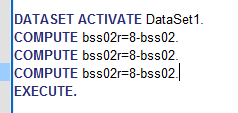
Now, change the second and third COMPUTE lines so they correspond to bss03 and bss07:
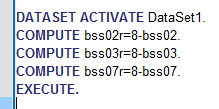
See what that’s doing? It is COMPUTE-ing three new variables: bss02r, bss03r, and bss07r. These new variables are based on their original values, but are each subtracted from 8 first. Make sure you have changed both sides of each equation in the syntax window: bss03r = 8-bss03, not 8-bss02. To run this syntax, click the Run menu and select All.
To see if you were successful, go to the Data Window and scroll to the right, past bss11. There should be three new variables:

Now that you have reverse-scored the necessary variables, you can proceed to analyzing reliability.